
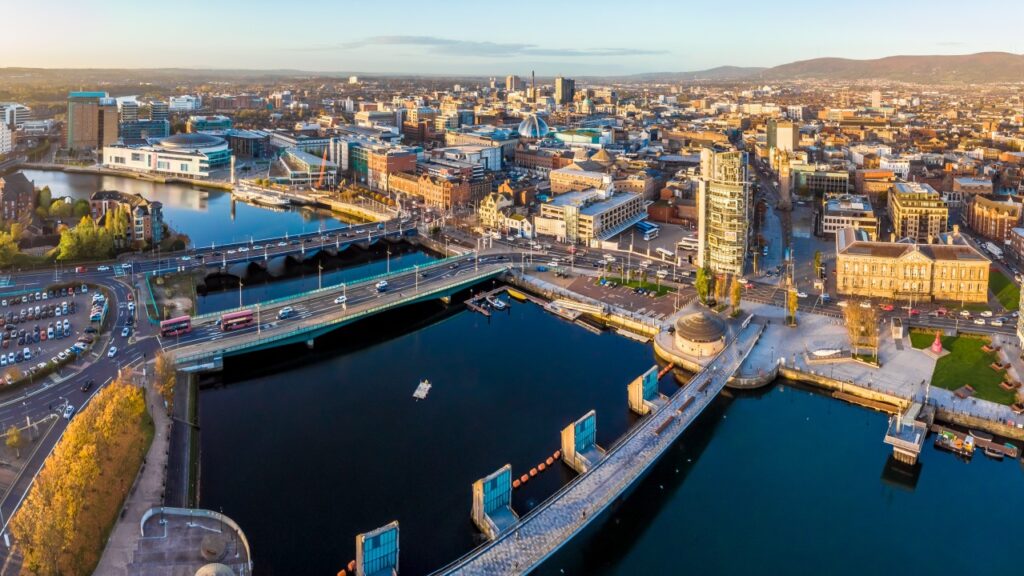
It’s been a decade since the Belfast City Centre Regeneration and Investment Strategy (BCCRIS) laid out an ambitious roadmap for transforming the heart of our city. Now, a decade later, it’s fair to say the pace has shifted up a gear and, as a business owner based in North Belfast, I’m watching closely.
The latest update confirms significant progress from new funding and physical transformation of key spaces to a renewed focus on connectivity and city centre living. But more than just bricks and mortar, there’s a shift in tone: this isn’t regeneration for its own sake. The language and public messaging is signifying regeneration with purpose which is anchored in community, sustainability, and inclusive economic growth.
A Decade On: Progress Worth Noting
According to the 2024 review, the city centre is now in far better health, with significant regeneration and development activity across multiple sectors. The retail sector, despite ongoing challenges, has shown remarkable resilience.
This is important because, in real terms, many analysts would consider city centres to be the heart of economic momentum, where it builds fastest. And, according to the BCCRIS (the strategy), the city centre is the engine room of investment, job creation, and public life. It’s where we thrive and the rest of the city follows.
I suppose the question is, would many of the independent businesses in the city centre agree with this assessment? Having heard of a couple I know closing just recently I wonder if there is a conversation to be had about the difference between a thriving city centre in terms of larger businesses vs smaller, independent ones? I’m not qualified enough to answer that, but I’m genuinely interested in hearing from those who are.

Nevertheless, recent infrastructure announcements support the vision of the city centre as the nucleus of economic momentum. Nearly £2.5 million in new public investment is now being deployed:
- £600,000 for the Under the Bridges project and Sailortown Bridge from the Department for Infrastructure
- £500,000 for e-bike rollout and active travel infrastructure
- £1.38 million in developer contributions for public realm works across Little York Street and wider city centre spaces
It’s a lot of investment and many businesses will want to know what this means in real terms. In other words, in their words, “what’s in it for me at the end of it all?”. A fair question to ask with some perceptions within the business community citing some of the BCCRIS as mere “vanity projects”.
However, new Lord Mayor Tracy Kelly said vanity is not the goal but rather these projects are about enabling connection, mobility, safety and vibrancy. She explained:
“It’s all about enhancing connectivity and placemaking to make the city centre more attractive, more vibrant and more accessible – a place where people want to be and spend time.”
In theory this isn’t just good for pedestrians getting around the city, it should have a positive knock on effect on footfall, trade, investment confidence and the kind of small business activity that a modern, mixed-use city desperately needs to survive.
A Shift Toward People and Place
What’s different about this next phase is the centrality of people in the plan. In November last year, Finance Minister Dr Caoimhe Archibald described the strategy as:
“A roadmap of policies… promoting an exciting vision for this city – one of inclusive growth where all communities benefit.”
It’s clear from this new narrative that city centre living, sustainable transport, and unlocking stalled regeneration schemes are a priority both at Executive and Council level and, in November, urban planner Joe Berridge, one of the original architects of the 2015 strategy, agreed:
“From my experience in comparable cities worldwide, increasing city centre living is the single most important strategy.”
That shift has implications. It means businesses need to start thinking not just about passing trade but about residents, tenants, hybrid workers and everyday users of the city centre. The “9-5 office commuter economy” is no longer the full picture.
What Does This Mean for Business Owners?
Let’s get to the brass tacks – what does it really mean on the ground for the business owners fighting to stay alive in the city, and beyond?
The original 2015 strategy set out clear goals:
- Increase the employment and residential population
- Manage the retail offer, create a green and walkable centre, support innovation
- Connect the city to surrounding neighbourhoods
Are we on track?
This is what we’re told:
- Employment zones have expanded, with major projects like the Ulster University campus and Belfast Grand Central station now acting as anchors.
- Grade A office stock has improved – though affordability and SME access remains an ongoing concern for many commentators and businesses in the city.
- Tourism has grown, and new cultural and food spaces are giving life to formerly underused buildings.
- The city centre is becoming greener and more walkable, with new streetscaping, bike schemes and waterfront planning underway.
But there are still challenges…
We still face gaps in delivery for some Special Action Areas. North East Quarter, Inner North and Inner West areas require ongoing attention and coordination. And while Cathedral Quarter and City Quays have seen notable vibrancy, many edge-of-core sites remain undeveloped or underutilised.
As a business owner in North Belfast, the continued disconnect between the city centre and surrounding neighbourhoods remains a sticking point. The planned Sailortown-Queen’s Island bridge and Under the Bridges initiative are vital, but we need to ensure the benefits reach beyond the postcard image and into real access to opportunity.
In lower North Belfast for example, where I’m from and where my business is located, it’s still considered an area of serious economic deprivation in the city. Yet it represents a community on a main thoroughfare, minutes from the city and connected by multiple public transport networks. Are we focusing on the city centre at the detriment to the immediate communities nearby? I don’t know? Not my area of expertise, but certainly a conversation I’d like to continue with those who do have the expertise.

Where Should Businesses Be Looking Next
There is real opportunity for property owners, retailers, start-ups and service providers. But they need to start future-proofing their place in the centre’s next chapter.
If your business can support:
- Flexible space use
- Placemaking activities
- Community-focused retail or services
- Active travel infrastructure
- Hybrid or hospitality experiences
…then now is the time to start showing up in city centre conversations.
Partnership and innovation are being openly invited. The strategy is clear: this isn’t top-down development. It’s a citywide collaboration.
“Let’s make Belfast a place where everybody can benefit from the opportunities being created,” said former Lord Mayor Micky Murray in November last year. “We’ve certainly faced, and continue to face challenges, but we tackle them in true Belfast style.”
A Living Strategy
Belfast’s regeneration strategy is no longer a vision on paper – it’s a living plan, now in its second half.
For entrepreneurs and business owners, this is a moment to pay attention. The infrastructure is coming. The principles of sustainability, inclusivity and connectivity are baked in. The city wants partnership.
The question is…how are you going to plug in? Me? I have no idea, but I’ll keep asking “how can I help?”…